Reasoning Isn't the Hard Part Anymore. Continuity Is.


This is a guest post by the maker of writenode, an AI note-taking Chrome extension built on Hindsight.
Large language models have gotten remarkably good at reasoning within a conversation. They're still surprisingly bad at continuity across them. Close the tab, come back next week, and most tools are starting over: no thread, no accumulated context, no sense that this is the fifth conversation about the same idea rather than the first.
I ran into this directly while building writenode, a Chrome extension for note-taking and AI-assisted thinking. The fix wasn't a bigger model or a cleverer prompt. It was treating memory as its own architectural layer, which is what led me to Hindsight.
Why continuity, not retrieval, is the actual goal
It's tempting to frame this as a retrieval problem: store everything, then fetch the relevant chunk when it's needed. But that framing misses what's actually happening when someone works with an AI tool over time.
People don't think in isolated prompts. A note from Tuesday is often the second half of a thought that started the previous week. Knowledge work spans days or weeks, not single sessions, and it's rarely linear: you circle back, revise earlier conclusions, and expect the tool to hold the shape of that revision, not just the words.
So the goal isn't better retrieval. It's preserving momentum. A system that only retrieves similar-looking text will happily hand you a stale version of your own thinking. A system built for continuity understands that your understanding of something changed, and carries the current version forward, not an average of every version you've ever written.
That distinction is what separates a chat wrapper with a search index bolted on from something that actually feels like it knows you.
How writenode carries that forward
Concretely, here's the shape of it:
Capture
   │
   ▼
Mode Classifier
   │
   ▼
Hindsight Memory Bank
   │
   ▼
Relevant Recall
   │
   ▼
LLM
   │
   ▼
Context-Aware Response
Every writenode user gets an isolated Hindsight memory bank, so continuity is scoped to that person's own history rather than a shared pool. Before anything reaches the memory layer, a lightweight classifier sorts incoming input into different modes — quick capture, deeper synthesis, structured planning — so Hindsight's recall pulls in the kind of context that mode actually needs, not a flat dump of everything the user has ever written.
The result is mundane to describe and genuinely different to use: open an old thread after a week away, and the tool picks it back up mid-thought instead of treating it as a blank page.
What it looks like in the product
That architecture surfaces in a few concrete places.
Node Gravity pulls relevant memories onto whatever page you're on, scoped to the nodes you've actually saved, so related thinking comes to you instead of you going to search for it.

Inside that panel, Find Related Memories connects the thing in front of you to the rest of your history — related nodes, plus the pages you've already been to.
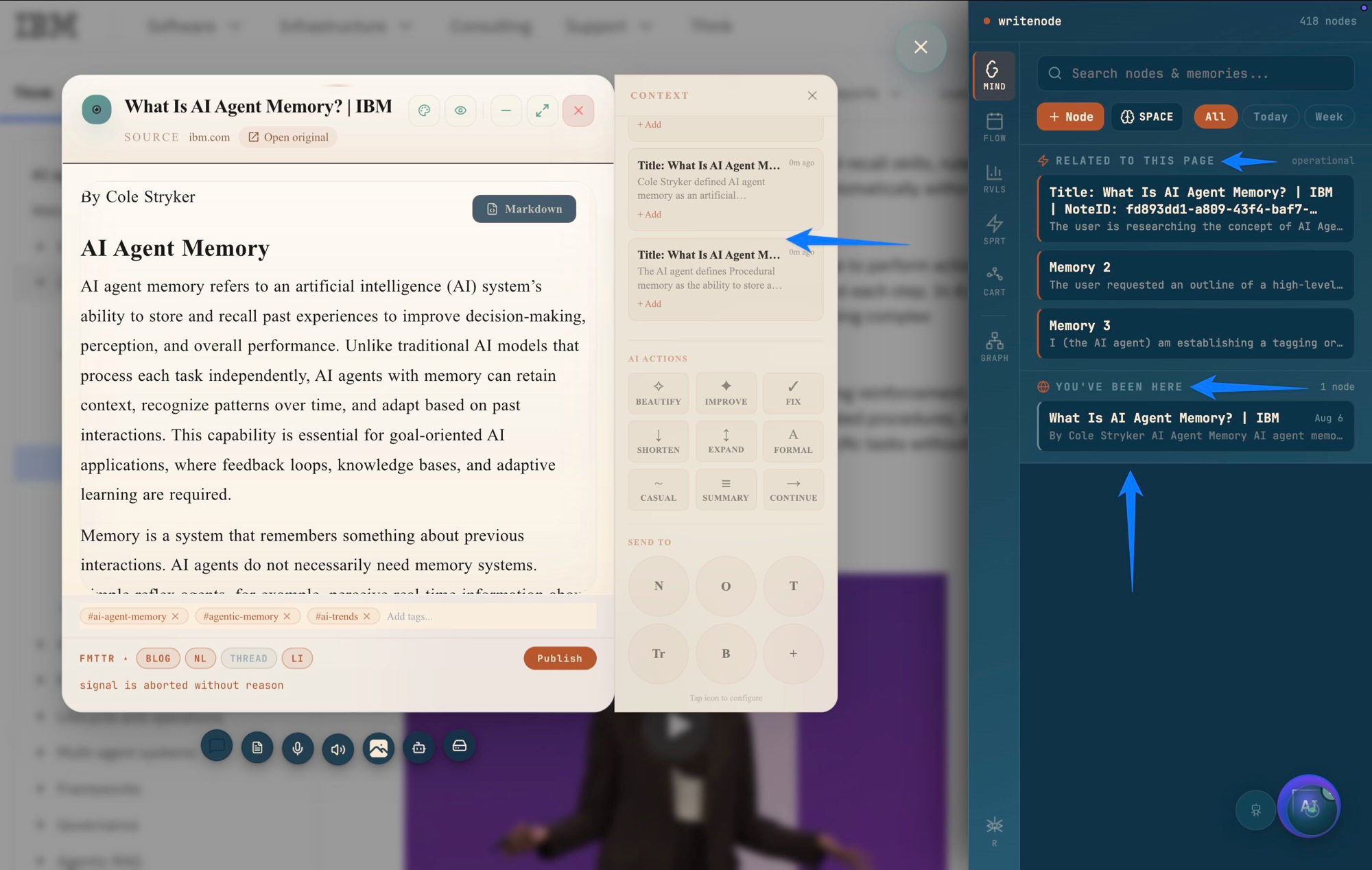
Because it rides on a per-user Hindsight bank, the continuity follows you across the web rather than living in one app. Open something unrelated like YouTube and it recognizes an interest you've been building over time.

And SOURCE NODE — the chat agent, powered by Gemini and Hindsight — lets you talk to everything you've captured. It pulls the relevant memories, then relates and connects them rather than handing back a flat list.

The same memory layer backs the web app I'm finishing now, and voice chat with SOURCE NODE is next — imagine a doctor talking through their own accumulated notes. Continuity follows you across surfaces instead of living in a single tab.
The bigger idea
AI is rapidly becoming capable of reasoning. The next frontier isn't reasoning, it's continuity. The applications that feel genuinely personal won't be the ones with the biggest models. They'll be the ones that can carry context forward without asking the user to rebuild it every session.
If you're curious what that looks like in practice, you can try writenode at writenode.app.
Further reading:
- What Is Agent Memory? — the memory-as-a-layer idea
- One Bank or Many? Structuring Agent Memory — how per-user isolation works
- Per-User Memory for AI Products — the multi-tenant patterns behind it