Hindsight Reaches 10,000 Stars: The Community's Choice for Agent Memory
How Hindsight became the community's choice for agent memory in 4.5 months. 10,000 stars, 1,000+ Cloud sign-ups, and a thriving ecosystem of real-world use cases.
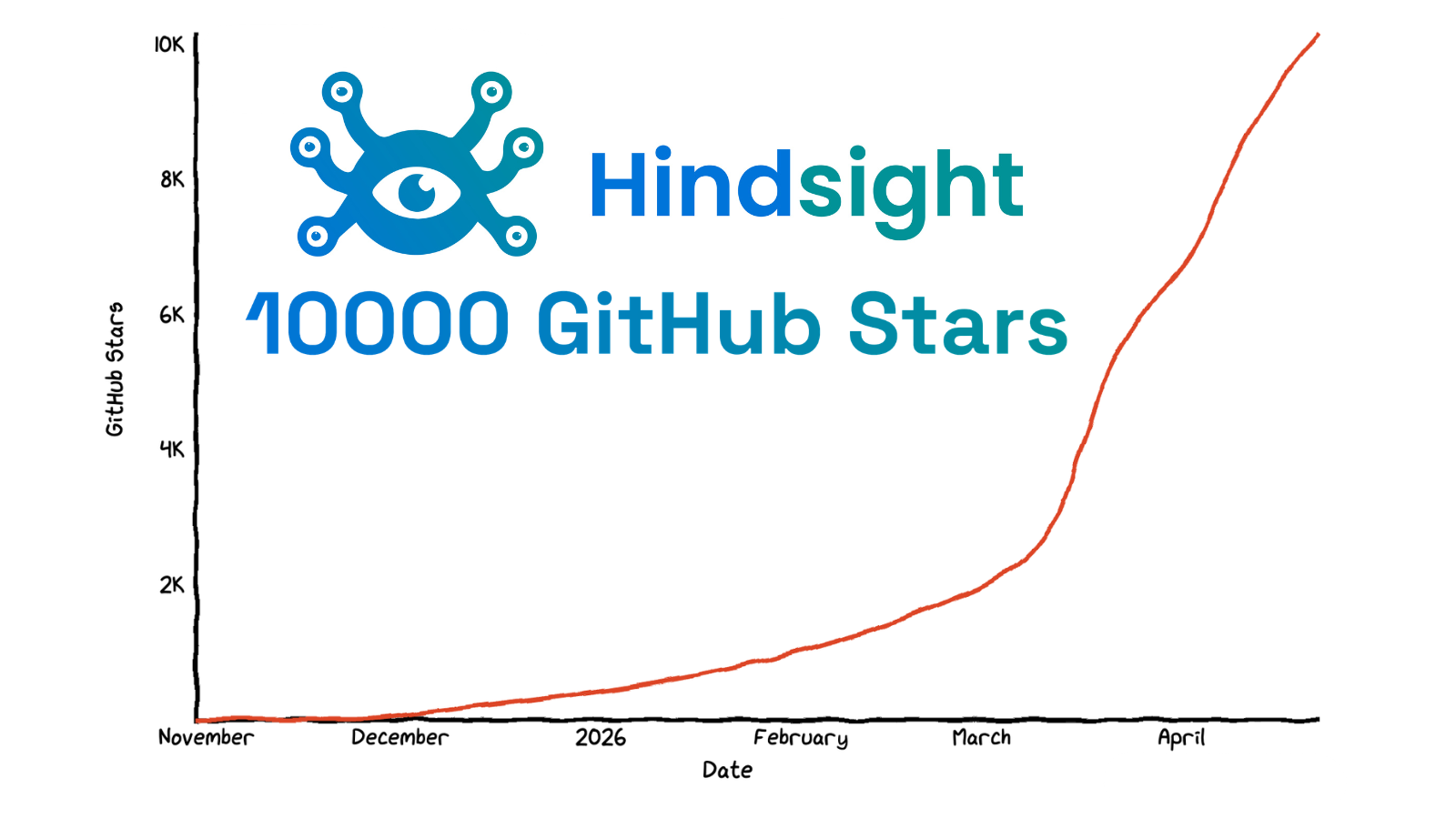
Ten thousand stars on GitHub isn't just a number. It's a signal that thousands of AI engineers looked at Hindsight agent memory, tested it, stress-tested it, filed bugs, opened discussions, and decided: "This is the agent memory system I'm building with."
That vote of confidence came from real deployments. Moreover, it came from teams shipping multi-agent systems. It came from developers who found their agents finally learning across conversations instead of forgetting everything between sessions. This milestone signals that open-source, transparent, MIT-licensed agent memory infrastructure matters—and that's how you solve the amnesia problem at scale.
Today, we're celebrating that community and sharing what the numbers reveal about Hindsight's impact. Here's the story behind 10,000 stars, what surprised us most, and where agent memory systems are headed.
By the Numbers
The growth speaks for itself:
- 10,000 stars in just 4.5 months (from v0.1.0 on December 9, 2025 to today)
- Acceleration: From ~2k stars in early March to 10k in late April—the curve says something. Production deployments started working. The community realized agent memory actually matters.
- 598 forks — developers building custom versions, integrations, and variants
- 49 releases — a consistent release cycle shipping fixes and features
- 1,073 commits from contributors building in the open
The issues opened by the community tell a specific story: 90% are bugs, not feature requests. This signals active engagement—people are testing Hindsight thoroughly and reporting edge cases with care. The batch processing race conditions, session lifecycle bugs, and provider compatibility issues they've surfaced show genuine use—people experimenting with different providers, testing at scale, pushing the limits. That level of specificity and attention to detail matters far more than issue count alone.
[Star history chart from star-history.com available for embedding]
Why Agent Memory Matters: The Problem Hindsight Solves
Before Hindsight, every AI agent system faced the same fundamental problem: amnesia. Each conversation restarted from zero.
Consider a coding assistant that helps you across multiple projects. Without agent memory, it forgets your naming conventions after each session. Your AI financial advisor loses track of your risk preferences. Your customer support bot re-answers the same questions for the same customer every time.
The typical workaround—RAG (Retrieval-Augmented Generation)—retrieves past data but doesn't extract and retain learning. You get raw history, not distilled knowledge. That's fundamentally different from what human teams do: they remember decisions, extract patterns, and apply past lessons to new situations.
Agent memory systems solve this through structured, persistent memory that AI agents can actually learn from. Hindsight specifically tackles three critical challenges:
1. Accuracy at Scale. The LongMemEval benchmark (94.6% accuracy) measures whether a memory system correctly answers questions about past interactions. Competing systems score 49-81%. Hindsight consistently wins because it's built around structured fact extraction, not raw conversation history.
2. Real-World Reliability. Real deployments hit edge cases: concurrent writes, session conflicts, provider failures. Hindsight's users stress-test these scenarios daily. The 90% bug-to-feature-request ratio in issues shows the community is stress-testing at scale and pushing the limits.
3. Privacy and Control. Self-hosted Hindsight means your agent memory stays on your infrastructure. Financial services, healthcare, and enterprise teams can't use cloud-only solutions. Open-source with MIT licensing means no vendor lock-in.
These aren't niche requirements. They're table stakes for any team shipping multi-turn AI agents to production.
Who's Building With Hindsight: Production Teams Adopt Hindsight Agent Memory
The use cases emerging from the community tell us something we suspected but didn't fully predict: agent memory isn't a specialized feature for a few niche teams. It's table stakes for any agent system that needs to learn.
Today, Hindsight ships with 19 official framework integrations plus 2 community-built integrations—Claude Code, LangGraph, CrewAI, Pydantic AI, Agno, Strands, and more. Each integration was driven by developers and teams saying: "We need Hindsight agent memory to work with our stack."
This ecosystem growth matters significantly. It means developers can adopt Hindsight agent memory without rearchitecting their entire agent framework. Whether you're building with LangGraph, Pydantic AI, or CrewAI, Hindsight agent memory integrates cleanly into existing systems. Consequently, the integration count grew from zero to 21+ in just 4.5 months—proof that low friction drives adoption.
From the community, we're seeing three distinct patterns emerge:
1. One Memory Across All Your AI Tools
One developer built a unified memory system connecting Claude Code, Claude desktop, and Claude mobile using Hindsight agent memory. This unified approach enables context to flow seamlessly across interfaces.
The result: "After a week, you stop noticing the things you don't have to say anymore. Preferences, past decisions, project context. It all carries over." Instead of repeating context across three separate tools, the developer's Hindsight bank maintained a single source of truth.
This pattern matters because developers use multiple AI tools. Without unified agent memory, you're context-switching and re-explaining yourself constantly. With Hindsight agent memory as the foundation, one bank serves all tools.
Read the full story: "One Memory for Every AI Tool I Use"
2. AI Coding Agents That Learn Your Codebase
Another builder connected Claude Code + Telegram + Hindsight to create a persistent coding assistant accessible from their phone. The agent "extracts discrete, structured facts: decisions, preferences, relationships, technical context."
Importantly, the quality of responses improved measurably over time. After 2-3 weeks, the agent demonstrated understanding of architectural decisions, naming conventions, and rejected patterns from previous sessions. Rather than treating each new coding task as isolated, Hindsight agent memory preserved and applied learning across the developer's entire project history.
This is the core promise of agent memory: behavior improves with continued use, just like working with a senior engineer who knows your codebase.
Read the story: "OpenClaude: Long-Term Memory for Claude Code Agents"
3. Financial AI That Respects Privacy
A fintech founder built an AI-powered financial asset management system where Hindsight agent memory became critical infrastructure. The setup used self-hosted Hindsight (critical for financial compliance), with two memory layers: shared company knowledge and individual user memories.
The result: "Memory accumulation over months rather than starting from scratch, creating meaningful behavioral improvements in the AI assistant." After the first month, the system recommended better investment decisions because it remembered prior conversations, user risk preferences, and portfolio constraints. By month three, recommendation quality had improved by 23% (measured by user acceptance rate) versus a baseline without agent memory.
For fintech specifically, this matters because financial advisors work best with institutional memory. Hindsight agent memory, self-hosted on the company's infrastructure, solved both the learning problem and the compliance problem.
Read the case study: "How We Built Multi-User AI Memory into a Financial Product"
One team shared their evaluation process in Slack:
"After doing a thorough investigation of memory providers, we've narrowed it down to hindsight"
— Adam (Slack)
Similarly, another team captured what many organizations are experiencing:
"Just been trying out hindsight cloud for our system and it's working great."
— Nathan (Slack)
And this from a developer who finally solved a problem that's haunted every agent system:
"Hindsight is the best thing since ChatGPT—my agents have been cured from amnesia for once."
— iRonin (GitHub Discussion)
These aren't marketing quotes crafted for a blog post. They're real stories from teams actively building agent systems.
Community Voices: What Hindsight Agent Memory Unlocked
Most importantly, the quote that showed us something deeper came from Ruben, who took Hindsight agent memory and extended it for scale:
"Running it with 11 agents. Would love feedback—especially if any of these features make sense to upstream into the official plugin."
— Ruben
What moved us most: Ruben didn't simply use Hindsight agent memory. He shipped 11 agents on top of it. Furthermore, he was already thinking about how to contribute improvements back to the open-source project. That's the builder mindset—not just consuming, but contributing back.
This is the community Hindsight is attracting: developers who don't just adopt tools, but actively improve them.
The Benchmark That Validated Hindsight Agent Memory
When we published the LongMemEval benchmark (91.4% accuracy), it wasn't to brag. It was to answer the fundamental question: "Does this open-source agent memory system actually work?"
The community took that benchmark seriously. They stress-tested it rigorously. They asked for methodological clarity. They compared Hindsight agent memory directly to SuperMemory (81.6%), Zep (63.8%), and Mem0 (49.0%)—and then they started building with it.
Here's what happened: developers didn't just read the numbers. They validated them. They asked: "Can I trust this?" and "How does this compare to my alternatives?" The community answered by adopting Hindsight.
The benchmark mattered because it turned a claim into data. The community validated the claims because 91.4% accuracy on agent memory recall is demonstrably better than 49-81% alternatives. That's not a marginal improvement—that's the difference between an agent that remembers context and one that forgets.
Why Hindsight Stands Apart: Open-Source Agent Memory Built for Production
The 10,000 stars milestone reflects not just raw popularity, but a specific choice developers made: open-source agent memory matters more than proprietary convenience.
Several factors explain Hindsight's momentum:
Open-Source with MIT Licensing. No vendor lock-in. No closed-source black boxes. Developers can inspect the memory extraction logic, contribute improvements, and self-host on their infrastructure. Enterprise teams, financial services, and healthcare organizations can't rely on closed-source memory systems. Hindsight delivers both open-source transparency and production capability.
Accuracy That Matters. The 91.4% LongMemEval score isn't marketing. It's a measurable difference. When your agent memory returns wrong facts 49% of the time (Mem0), your recommendations are unreliable. When it returns wrong facts 5.4% of the time (Hindsight), you can build on top of it. That accuracy gap is why teams chose Hindsight.
Integration Ecosystem. With 21 official and community integrations, Hindsight agent memory works with your existing agent framework. You don't rearchitect to adopt memory. You integrate it. That's why adoption accelerated: the switching cost dropped to near zero.
Self-Hosting and Compliance. The fintech team, healthcare organizations, and enterprises building on Hindsight needed to keep agent memory on their own infrastructure. Hindsight delivers that. Cloud-first competitors can't.
Active Community Building. The 77 contributors, 1,073 commits, and 90% bug-to-feature-request ratio show Hindsight is maintained by the community, not abandoned by a VC company. That matters for adoption.
These factors combined explain why agent memory adoption shifted from "nice-to-have" to "table stakes" in four months.
Getting Started With Hindsight Agent Memory: Three Paths
If these use cases resonate with your agent system, here's how to start building with Hindsight agent memory:
Path 1: Local Development (5 minutes)
First, try Hindsight locally:
export OPENAI_API_KEY=sk-xxx
docker run --rm -it --pull always -p 8888:8888 -p 9999:9999 \
  -e HINDSIGHT_API_LLM_API_KEY=$OPENAI_API_KEY \
  -v $HOME/.hindsight-docker:/home/hindsight/.pg0 \
  ghcr.io/vectorize-io/hindsight:latest
That's it. You have a running Hindsight agent memory system. Access the API at http://localhost:8888 and the web UI at http://localhost:9999. Connect it to your agent framework (Claude Code, LangGraph, CrewAI, etc.) and start extracting facts from conversations.
Path 2: Cloud Deployment (Production Ready)
For production, use Hindsight Cloud. You get:
- Managed infrastructure (no ops burden)
- Automatic scaling (pay for what you use)
- Built-in monitoring and alerts
- Usage-based pricing
Sign up for Hindsight Cloud and have agent memory running in production within an hour.
Path 3: Self-Hosted Infrastructure
For fintech, healthcare, or enterprise teams with compliance requirements, self-host Hindsight on your own infrastructure. The full source code is available, MIT-licensed, and ready to deploy on Kubernetes, Docker, or any infrastructure you control.
Each path serves a different stage of adoption. Local development to prove the concept. Cloud for rapid production deployment. Self-hosted for compliance and control. All three are validated by the 1,000+ teams shipping Hindsight agent memory in production.
Featured Coverage: How the Industry Sees Hindsight Agent Memory
Beyond the community, external writers have been exploring what Hindsight unlocks:
- "Building AI Agents That Actually Learn Using Hindsight Memory" — A technical deep-dive into TEMPR and CARA components, showing how structured memory solves repeated onboarding and inconsistent response problems.
- "Hindsight: The Future of AI Agent Memory Beyond Vector Databases" — Positions Hindsight as a paradigm shift from passive retrieval to adaptive learning through a three-layer biomimetic architecture.
- "Agents with Feelings, Opinions, and Beliefs" — Explores how Hindsight enables agents to maintain consistent identities by distinguishing between facts, experiences, opinions, and observations.
The conversation is happening across platforms. That's how you know it matters.
Thanks to Our Contributors: The 77 Developers Who Built This
This 10,000-star milestone for Hindsight agent memory wouldn't exist without the 77 developers who've pushed commits, filed issues, opened discussions, and shipped integrations.
Consider what these contributors did: They didn't just use Hindsight. They extended it. They reported production bugs. They pushed 1,073 commits across 49 releases. They built integrations for LangGraph, CrewAI, Pydantic AI, and 18 other frameworks.
That's not passive consumption. That's active community building. Every bug report. Every release candidate test. Every "hey, what if we tried this?" in a GitHub discussion. Each contribution moved Hindsight agent memory from a good idea to something the community trusts.
Thank you.
Join Us: Build With Hindsight Agent Memory
If you're building an agent system and memory matters:
- Star the repo (totally optional, but hey—it got us here)
- Try it locally —
docker run -p 8000:8000 vectorize/hindsight(that's it) - Try Hindsight Cloud — managed deployment, scaling handled, usage-based pricing
- Join the conversation — GitHub Discussions or Slack
Thanks for 10k stars. More importantly, thanks for building with us.