Your 1M-Token Context Window Is Not Memory
A context window is working memory: it forgets everything when the session ends and degrades long before it fills. Why a bigger window is still not agent memory.
 By Ben Bartholomew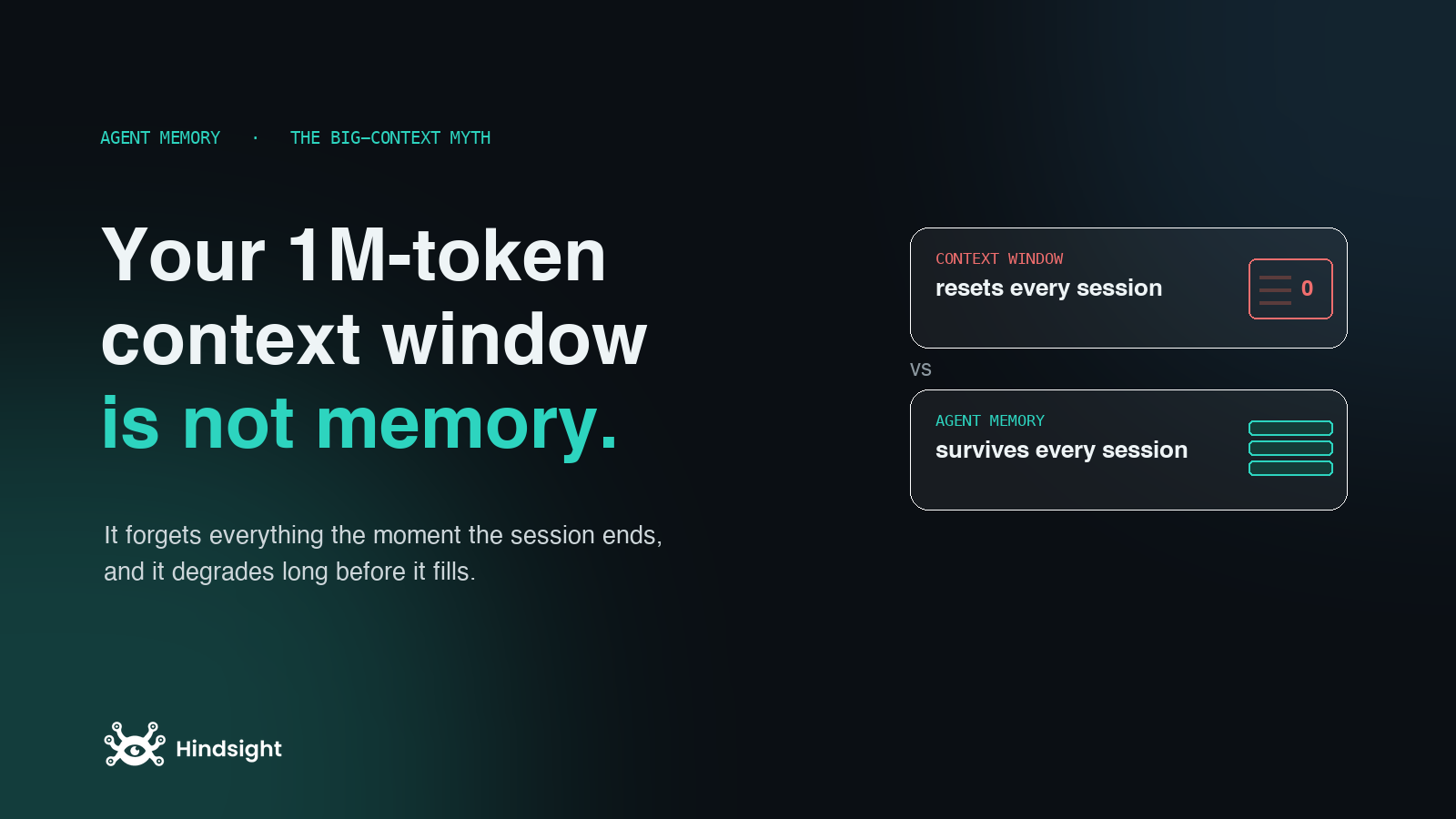
Every time a lab ships a bigger context window, the same take goes viral: memory systems are dead, just put everything in the prompt. Inkling and Gemini reason over a million tokens. Claude Sonnet does a million. Llama 4 Scout advertised ten million. Surely, the argument goes, you can now paste your entire history into the window and skip the whole idea of a memory layer.
You cannot, and the reason is not a limitation that a bigger window fixes. A context window is not memory. It is working memory, and it has two properties that disqualify it from the job no matter how large it gets: it forgets everything when the session ends, and it gets worse at using what you give it long before it is full.
A context window is RAM, not disk
Think of the context window as your agent's RAM. It is fast, it is where the actual thinking happens, and it is completely volatile. When the request ends, it is gone. The model does not "have" the million tokens you sent last Tuesday. It re-reads whatever you hand it, every single call, from scratch.
Agent memory is the disk. It persists across sessions, it survives a restart, and it is where knowledge lives when nobody is actively thinking about it. Confusing the two is the whole mistake. Asking a context window to be your memory is like asking your RAM to be your hard drive because you bought a lot of RAM. More of it does not change what it is for.
| Context window | Agent memory | |
|---|---|---|
| Survives the session? | No, resets every call | Yes, persists across sessions |
| Quality as it grows | Degrades (context rot) | Recall stays focused |
| Stores raw text or knowledge? | Raw tokens | Consolidated facts and observations |
| Resolves entities and dates? | No | Yes |
| Forgets or updates stale info? | No | Yes, via recency and consolidation |
| Shared across agents and tools? | No, one session | Yes, one bank, many surfaces |
Here is what that means in practice, in four parts.
1. It does not persist
This is the disqualifying one. Open a fresh session tomorrow and the window is empty. Everything the agent "knew" a moment ago is gone unless something outside the model put it back.
So the instant you want an agent that remembers across sessions, you need a store that lives outside the context window. That store is a memory system, by definition, whether you self-host it or spin up a managed bank on Hindsight Cloud. The size of the window is irrelevant to this. A ten-million-token window that resets every session remembers exactly as much as a two-thousand-token one: nothing.
2. It rots long before it fills
Even inside a single session, the "just paste everything" plan quietly fails, and there is now hard data on this.
Researchers at Stanford and Berkeley documented the lost-in-the-middle effect back in 2023: models attend well to the start and end of a long context and poorly to the middle, with accuracy dropping more than 30 percent when the relevant fact sits in the middle rather than the edges. It got a name in 2025 when Chroma published a study on context rot, testing 18 frontier models and finding accuracy drops of 30 to 50 percent well before the documented window limit is reached. Performance does not decline gracefully either. It falls off cliffs, with some models fine at 32K tokens and collapsing at 64K.
It gets worse the more your data looks like itself. When the distractors in the context are semantically similar to the answer, which is exactly the situation when you dump a whole project history in, accuracy collapses faster. So the naive plan, stuff the window and let the model sort it out, is not just expensive. It actively makes the model dumber at finding the one thing that mattered.
A smaller, relevant context beats a giant, noisy one. That is not a workaround. That is the finding.
3. It is a raw dump, not knowledge
A context window holds whatever text you put in it. It does not understand that "Ben" in message 3 and "he" in message 300 are the same person. It does not notice that a decision from March was reversed in June. It does not turn a rambling conversation into durable facts.
A memory system does exactly those things before anything reaches the model. It extracts facts from raw text, resolves entities so "Ben" and "he" collapse into one, timestamps events, and consolidates repeated mentions into higher-confidence observations. It reconciles contradictions and lets stale information fade by weighting recent, well-supported facts over old ones. A transcript in a context window is data. What comes out of a memory system is knowledge, and the difference is the processing that a raw window never does.
4. You still have to choose what goes in
Here is the part the "big window kills memory" crowd skips. Even with a million tokens, you have a budget, and you have context rot, so you cannot put everything in. You have to select the relevant slice. That selection problem, deciding what the model should see for this specific turn, is not a side quest. It is the entire job of memory.
So you never actually escape memory by buying a bigger window. You just move the selection problem somewhere and hope it solves itself. It does not. Retrieval that picks the right handful of facts and injects only those is what keeps the context small, and small is what keeps the model sharp.
The two are complements, not competitors
None of this means big context windows are bad. They are great. They are where reasoning happens, and having room to reason is a real gain. The mistake is treating the window as the store.
The clean architecture is boring and correct: memory is the durable, consolidated, cross-session store, and on each turn it recalls a small, relevant, high-signal slice and hands that to the context window to reason over. The window stays lean, so it does not rot. The knowledge survives the session, because it never lived in the window to begin with. You get the best of both: a model thinking over exactly what it needs, backed by everything it has ever learned.
This is what a system like Hindsight is for. It retains facts from every exchange, consolidates them into observations, resolves entities and dates, and on recall returns the tight set that matters for the current query, not the whole history. You can run it yourself or start free on Hindsight Cloud in a couple of minutes. Either way, the context window does the thinking, and memory decides what is worth thinking about.
The test that settles it
If you still are not sure whether you need memory or just a bigger window, ask one question: should your agent remember this after the session ends?
If no, the context window is fine. Put it in the prompt and move on. If yes, no window size will ever help you, because the window does not survive the session. You need a memory. That is the line, and it does not move when the window gets bigger.
A 1M-token context window is a phenomenal place to think. It is a terrible place to remember. Give your agent both, and stop asking one to do the other's job.
Further reading
- One bank or many?: how to structure that memory once you have it.
- One memory for every AI tool: why the store lives outside any one model or session.
- We made Inkling an agent memory engine: plugging an open model into the memory pipeline.