Teach Vercel Eve to Remember: Automatic Agent Memory
Vercel Eve agents get automatic long-term memory with hindsight-eve v0.2.0: context injected before every turn, each exchange saved after, no model tool call.
 By Ben Bartholomew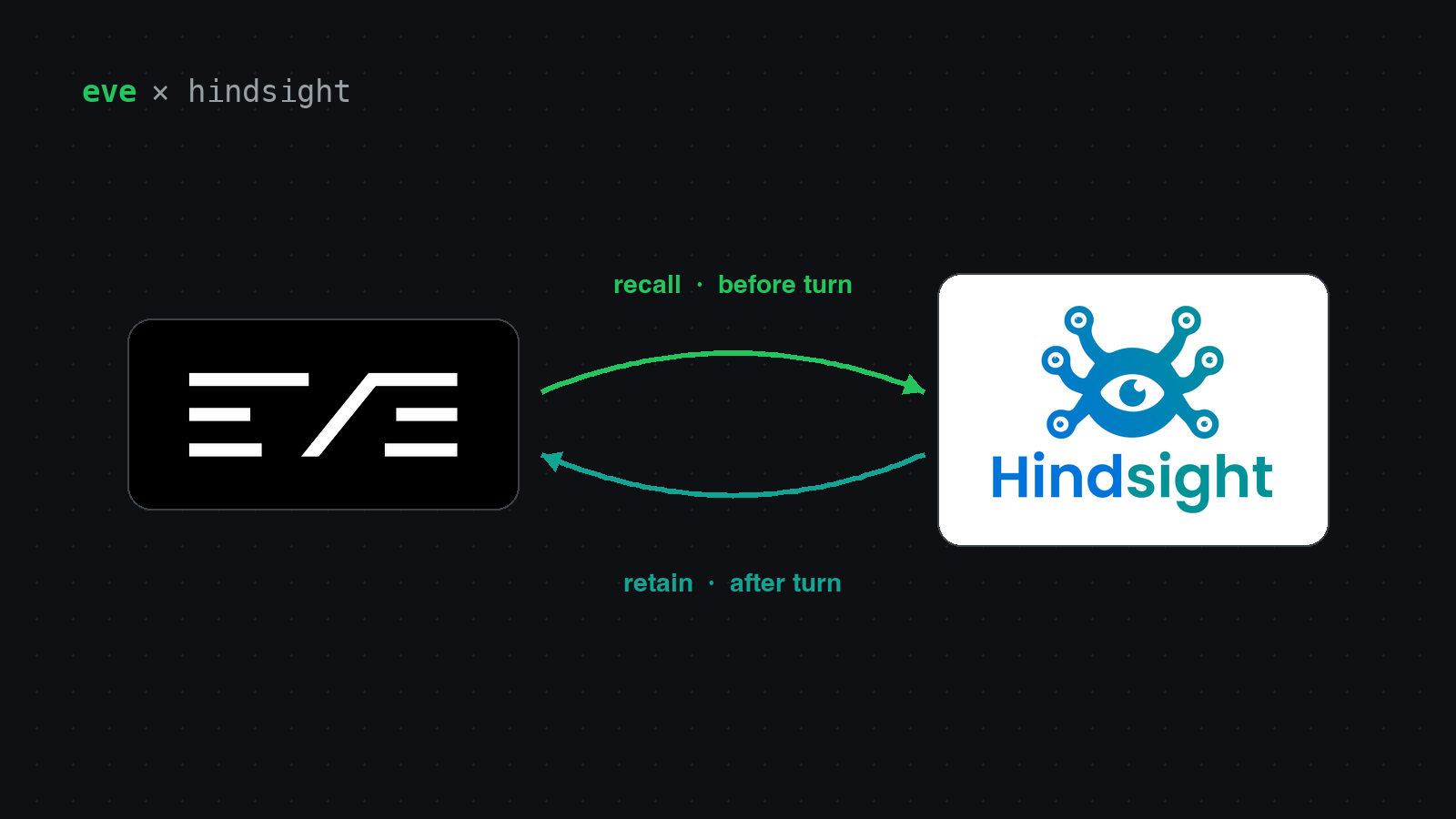
Vercel Eve is an open-source, filesystem-first framework for building AI agents: an agent is a directory of files, a tool is one TypeScript file, and a skill is one Markdown file. Vercel announced it in June 2026, and it ships production features like durable execution, sandboxed compute, and OpenTelemetry tracing by default. What it does not ship is long-term memory, and that is where Hindsight comes in.
The first version of the Hindsight integration for Eve gave the agent memory tools: recall, retain, and reflect, exposed over MCP for the model to call. That works, but it has a catch common to every tool-based memory setup. The model has to decide to use it. If it doesn't reach for recall, the memory may as well not exist.
@vectorize-io/hindsight-eve v0.2.0 removes that dependency. Memory is now automatic: relevant context is injected before every turn, and each exchange is saved after, without the model ever choosing to call a tool.
TL;DR
- v0.2.0 switches from model-called memory tools to automatic memory.
- Two authored files: an instructions resolver that recalls before each turn and injects the result as a system message, and a hook that retains after each turn.
- Both call Hindsight's REST API directly, so memory never depends on the LLM deciding to act.
- Recall is profile-based, not per-message (the resolver can't see the live user message). It is ideal for "the agent knows you," and tunable.
- Works with Hindsight Cloud or a self-hosted server; retains run async and never block a turn.
Why Automatic Beats a Memory Tool
A tool-based memory layer is only as reliable as the model's judgment about when to use it. Give an agent a recall tool and it will use it sometimes: when the prompt obviously calls for history, when it happens to think of it. The rest of the time it answers from a cold context and quietly forgets that you always want Python with type hints, or that this project standardised on a particular convention last week.
That unreliability is the whole problem agent memory is supposed to solve. If remembering is optional, you are back to a stateless agent that occasionally remembers. Making recall and retain automatic, on every turn, is what turns "has a memory tool" into "actually remembers."
How Eve's Automatic Memory Works
Eve is filesystem-first: an agent gains behaviour by dropping a file into the project. The v0.2.0 integration wires two of them, and neither exposes a tool to the model.
agent/instructions/hindsight.ts is a dynamic instructions resolver. On turn.started, before the model runs, it recalls from your Hindsight bank and injects the results as a system message. The block is fenced with a sentinel comment so recalled facts are never re-retained on the way back out.
agent/hooks/hindsight.ts is a hook. On turn.completed, it retains the exchange to the bank: by default both the user's message and the assistant's reply, since the reply is usually where the answer lives. Retains run asynchronously, so they never add latency to a turn, and failures degrade quietly through an onError callback rather than breaking the agent.
Both files call Hindsight's REST API directly (recall via POST /v1/default/banks/{bank}/memories/recall, retain via POST /v1/default/banks/{bank}/memories). There is no MCP server and no tool for the model to call. Memory happens around the turn, not inside it.
Install and Quick Start
npm install @vectorize-io/hindsight-eve
eve is a peer dependency, so you already have it in an Eve project. Then create two files:
// agent/instructions/hindsight.ts
import { hindsightMemory } from "@vectorize-io/hindsight-eve";

export default hindsightMemory();
// agent/hooks/hindsight.ts
import { hindsightRetainHook } from "@vectorize-io/hindsight-eve";

export default hindsightRetainHook();
That is the whole integration. Both read their config from the environment:
| Env var | Purpose |
|---|---|
HINDSIGHT_API_KEY | Bearer token, sent as Authorization: Bearer <key> |
HINDSIGHT_API_URL | Hindsight REST base (defaults to Hindsight Cloud) |
HINDSIGHT_BANK_ID | Bank to scope memory to (defaults to default, auto-created) |
Point both files at the same HINDSIGHT_BANK_ID so recall and retain share one store (for example, one bank per user).
Recall Is Profile-Based, Not Per-Message
This is the design trade-off worth understanding. Eve's instruction resolver runs at the start of a turn, before the live user message is available to it. So recall can't be query-specific to what the user just asked. Instead it uses a fixed, broad query (the default is "user preferences, identity, and working context") to surface the user's ambient profile every turn.
That is exactly right for the "the agent knows you" case: preferences, identity, ongoing project context, the durable things that should shape every reply. It is deterministic, and you can tune the query with the recallQuery option to match what your agent should always keep in view.
What it is not is per-message semantic retrieval. Pulling the three most relevant facts for this specific question inherently needs a tool the model calls at the right moment, and that is out of scope for the automatic path by design. If you need both, the two approaches compose: automatic profile recall for the ambient context, a called tool for targeted lookups.
Cloud or Self-Hosted
For Hindsight Cloud, set HINDSIGHT_API_KEY to a key from your dashboard. HINDSIGHT_API_URL defaults to https://api.hindsight.vectorize.io, so there is nothing else to configure.
For a self-hosted server, point at your own base URL. If it runs without auth, pass apiKey: null:
import { hindsightMemory } from "@vectorize-io/hindsight-eve";

export default hindsightMemory({ apiUrl: "http://localhost:8000", apiKey: null });
Both factories accept the same options, each falling back to its env var:
| Option | Default | Purpose |
|---|---|---|
apiUrl / apiKey / bankId | env, then Cloud | connection and bank (apiKey: null = no auth) |
recallQuery | "user preferences, identity, and working context" | the broad query used for recall |
budget | "mid" | recall result budget (low / mid / high) |
maxTokens | 1024 | recall token budget |
includeAssistantReply | true | retain the assistant's reply too; set false to store only the user's message |
context | "eve" | the context tag written on retained items |
onError | console.warn | where recall/retain failures degrade to |
Verify It Works
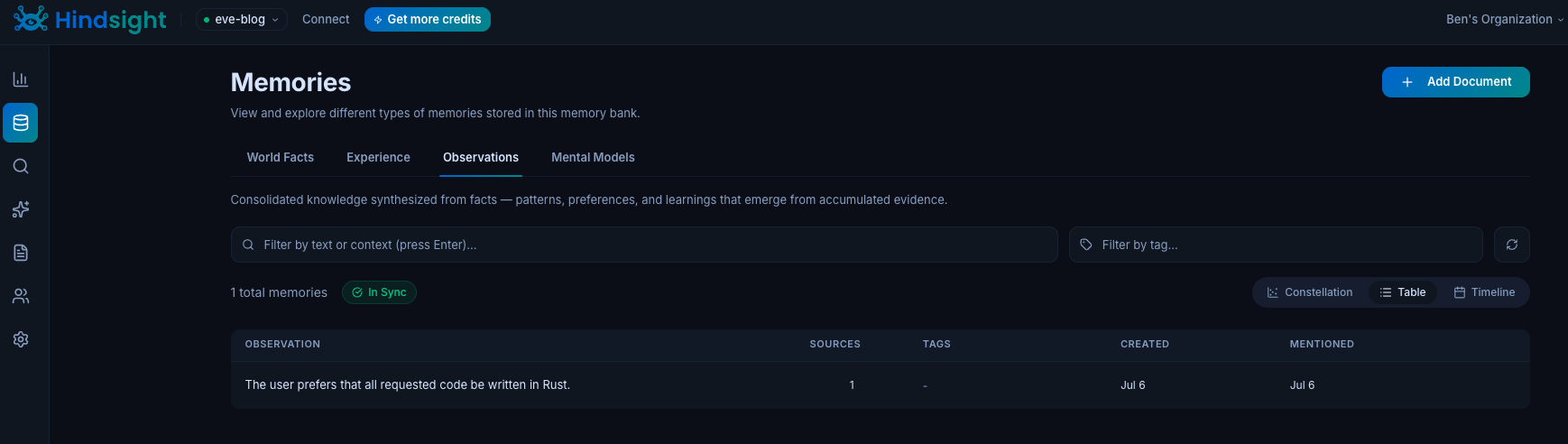
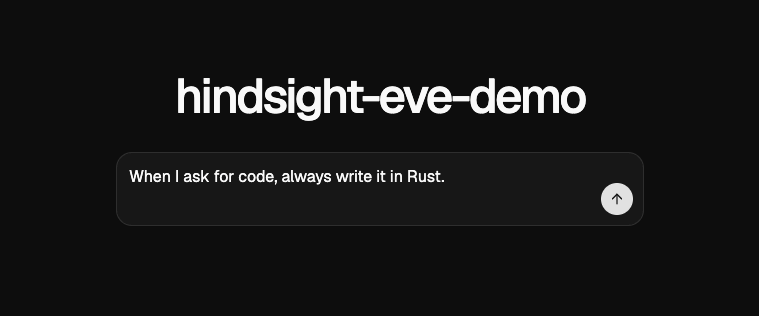
Run your agent and tell it a durable preference in one chat, for example "when I ask for code, always write it in Rust."
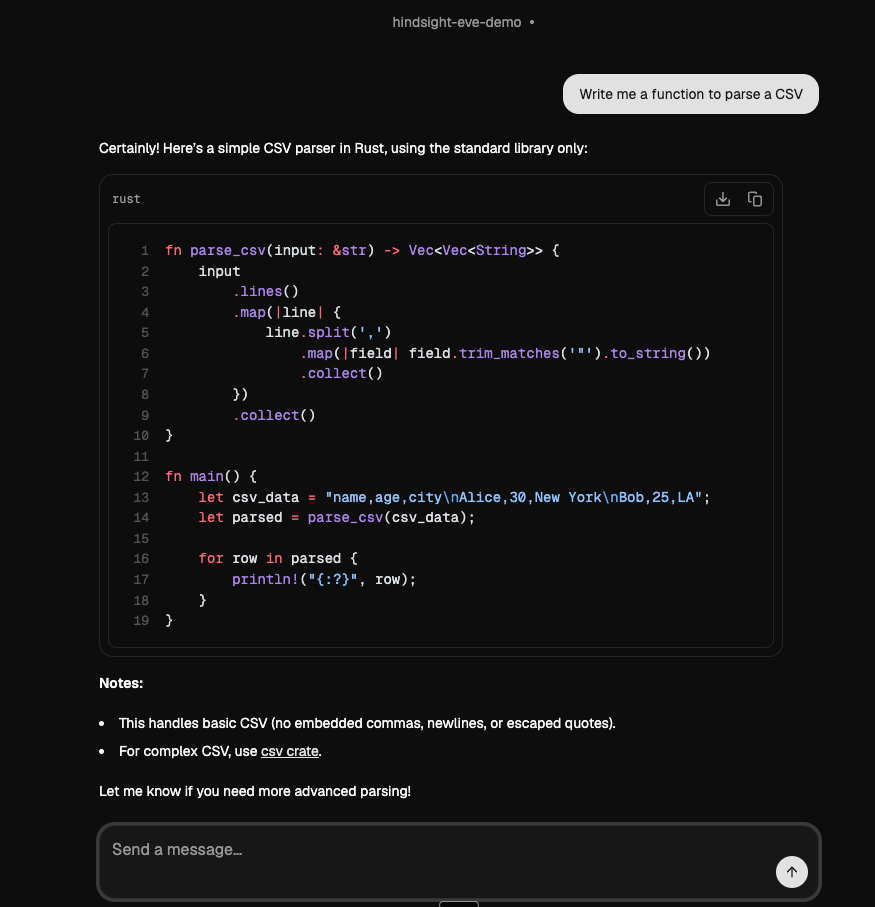
Then start a fresh chat and ask for something. The agent applies the remembered preference, because the memory was injected as a system message before the model ran, with no tool call and no prompting from you.
Frequently Asked Questions
Does the model have to call a tool to use memory? No. That is the point of v0.2.0. Recall is injected before the model runs, and retain happens after the turn via a hook. The model never sees or calls a memory tool.
What gets recalled each turn?
Your ambient profile: preferences, identity, and working context, via a fixed broad query. The instruction resolver runs before the live user message is available, so recall is profile-based rather than per-message. Tune it with recallQuery.
Does it store the assistant's replies too?
Yes. By default it retains both the user's message and the assistant's reply, because the reply is usually where the real signal lives: the decision it reached, the solution it described, the code it wrote. If you would rather keep only what the user said, set includeAssistantReply: false.
Does it add latency?
Retains run asynchronously and never block a turn; recall is a single call before the turn. Failures degrade through onError rather than breaking the agent.
Further reading
- What is agent memory?: the foundational concepts behind recall and retention.
- Best AI agent memory systems: how the major agent memory frameworks compare.
- Vercel AI SDK persistent memory: memory for the other Vercel agent stack.
- One memory for every AI tool: point Eve and your other agents at the same bank.