Staleness-Aware Memory: When Your Agent Should Verify Before It Trusts

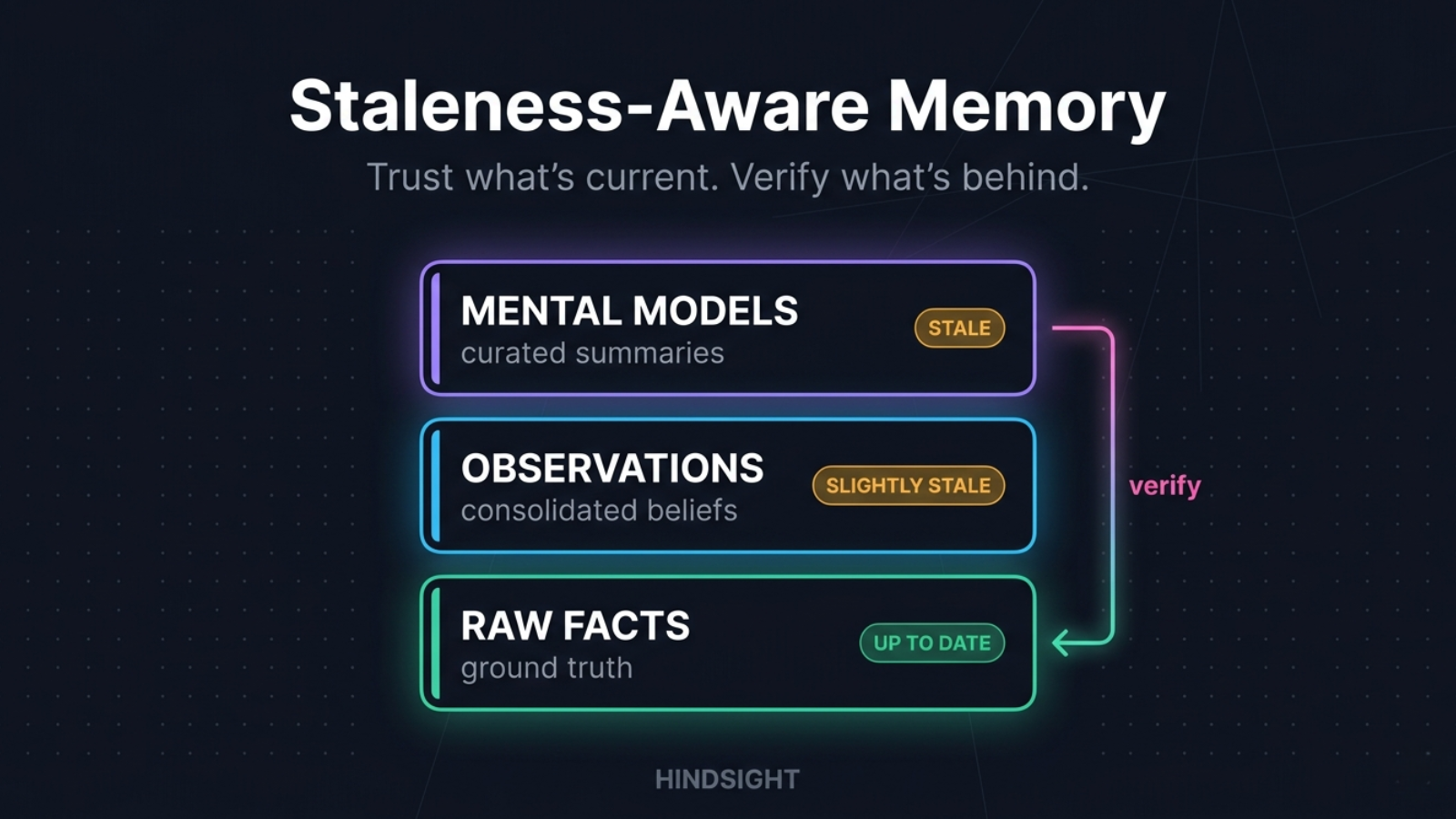
Most agent memory has a silent failure mode: it serves whatever it has and never tells you whether that's current. The retrieval layer returns the closest match by similarity and stays quiet about whether the match still reflects reality. For a demo that's fine. In production, an agent that confidently answers from a stale snapshot isn't remembering, it's guessing with conviction.
Hindsight has a specific reason this risk is real, and a specific mechanism to handle it. Its fast, high-level memory is derived memory: observations and mental models are consolidated from raw facts in the background. Derived data can lag the source. So rather than pretend the consolidated layer is always current, Hindsight measures how far behind it is and lets the reflect agent decide when to verify against ground truth.
TL;DR
- Hindsight has three retrieval layers: mental models (curated summaries), observations (consolidated beliefs), and raw facts. The first two are derived and refreshed asynchronously, so they can lag new writes.
- When the reflect agent reads a consolidated layer, Hindsight attaches an
is_stalesignal so the agent knows whether that layer has caught up with recent memories. - For observations, staleness is graded by how many retained memories are still waiting to be consolidated:
up_to_date,slightly_stale, orstale. - For mental models,
is_staleis true when new in-scope memories have been ingested since the model was last refreshed. - The reflect loop uses this as a routing decision: if a layer is stale, it drops to
recall()and verifies against raw facts before answering. Current layers are trusted directly.
Why Consolidated Memory Lags
The thing that makes Hindsight fast to write to is the same thing that creates the lag.
When you retain(), the raw facts land immediately. Consolidation, which folds those facts into deduplicated observations, runs in the background afterward. That keeps the retain call quick, but it means there's always a window where the observations in a bank are a slightly older view of what the bank has actually been told. Mental models are even further removed: they're refreshed periodically, so between refreshes new memories pile up underneath a summary that doesn't yet reflect them.
This isn't a bug, it's the cost of having a fast, synthesized layer at all. The question is what the system does about it. A flat store does nothing and serves the old view. Hindsight measures the gap and surfaces it.
The Staleness Signal
Hindsight's reflect agent works through a hierarchy, cheapest and most-synthesized first:
- Mental models: curated, high-level summaries.
- Observations: consolidated beliefs grounded in evidence.
- Raw facts: ground truth, retrieved with
recall().
When the agent reads either of the derived layers, the result carries an is_stale flag. The two layers compute it differently, because "behind" means something slightly different for each.
Observations: graded by consolidation backlog
When the agent searches observations, Hindsight reports how far consolidation has fallen behind, based on the number of retained memories still waiting to be consolidated:
| Pending (unconsolidated) memories | Signal |
|---|---|
| 0 | up_to_date |
| under 10 | slightly_stale |
| 10 or more | stale |
is_stale is simply true whenever anything is pending. The grade exists so the agent can treat "one memory behind" differently from "fifty memories behind."
Mental models: behind since last refresh
Mental models refresh on their own cadence, so their staleness is about that refresh boundary. A mental model is marked is_stale when new in-scope memories have been ingested since it was last refreshed, with that exact reason attached. It tells the agent: this summary was accurate as of its last refresh, but the world has moved since.
How Reflect Uses It
The signal isn't decorative. It's a routing decision baked into the agent's instructions: read the cheap layer first, and if it's stale, don't stop there. Verify against a lower layer before committing to an answer.
Concretely:
- A fresh, relevant mental model can answer a question on its own.
- A stale mental model gets cross-checked: the agent also searches observations, and if those are stale too, it calls
recall()for raw facts. - Stale observations that are central to the answer get verified against the underlying memories the same way.
So the agent spends its retrieval budget exactly where it's warranted. When the synthesized layers are current, it trusts them and answers cheaply. When they're behind, it pays the cost of going to ground truth instead of confidently serving a snapshot that consolidation hasn't caught up to yet.
That's the whole idea: staleness is a signal to verify, not to discard. A stale observation isn't thrown away, it's confirmed against the raw facts before the agent relies on it.
Why This Matters
Without a staleness signal, a synthesized memory layer has no way to be honest about its own lag. You get failures like:
- Answering from a summary that's a week behind. The user changed direction yesterday; the mental model still reflects last week, and nothing flags it.
- Trusting consolidated beliefs while a backlog sits unprocessed. Fifty new memories were just retained, none consolidated yet, and the agent answers from observations as if they're complete.
- No way to tell "current" from "probably current." Every consolidated answer carries the same implicit confidence regardless of how stale it is.
Staleness-aware retrieval turns "here's the closest synthesized match" into "here's the closest match, and here's whether you should double-check it." The agent reasons about currency, not just relevance.
It complements how Hindsight handles contradictions during consolidation: when a new fact reverses an old one, the observation is rewritten to capture the change rather than overwritten. Staleness covers the gap before consolidation catches up: the moment when new memories exist but the synthesized layer hasn't folded them in yet.
Recap
| Flat memory store | Staleness-aware memory | |
|---|---|---|
| Synthesized/summary layer | Served as-is | Flagged with is_stale |
| Knows it's behind on writes | No | Observations graded by consolidation backlog |
| Knows a summary predates new facts | No | Mental model stale "since last refresh" |
| Behavior when behind | Serves the stale view | Reflect verifies against raw facts |
| Trust model | Uniform confidence | Trust when current, verify when stale |
Next Steps
- Observations: How consolidation works
- Reflect: The agentic retrieval loop
- Recall: Retrieving raw facts
- Related reading: The Consolidation Problem in Agent Memory
- Try it: Hindsight Cloud or self-host with one Docker command