hs-decide-1-flash goes multimodal, with longer context and better performance
An updated checkpoint of our 0.8B decision model accepts images, takes requests up to 131,072 tokens, and scores higher on our evals and the Decision Index.
 By Andrew Neeser
Our decision model now sees images. Today we're releasing an updated checkpoint of hs-decide-1-flash. It takes a mix of text and images and handles requests up to 131,072 tokens, up from the 65,536 the first checkpoint was trained on. It scores higher overall on our evals and raises its Decision Index score. It's available now as open weights on Hugging Face and on Hindsight Inference.
TL;DR
- Images. The same model makes decisions about photos, screenshots and PDF pages, and ranks them alongside text.
- Twice the context. Requests up to 131,072 tokens, so Hindsight ranks about 320 memories in one request instead of 160.
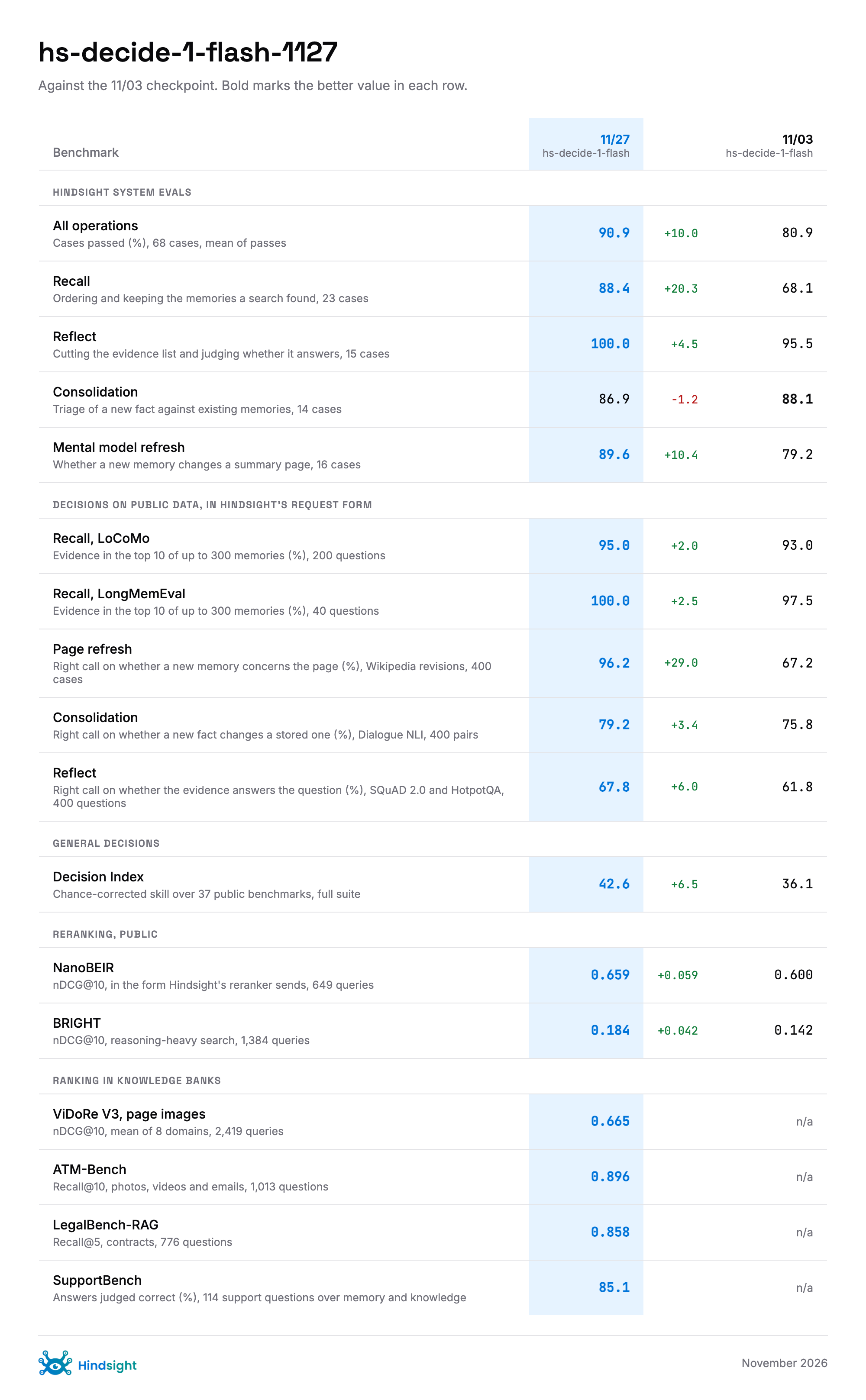
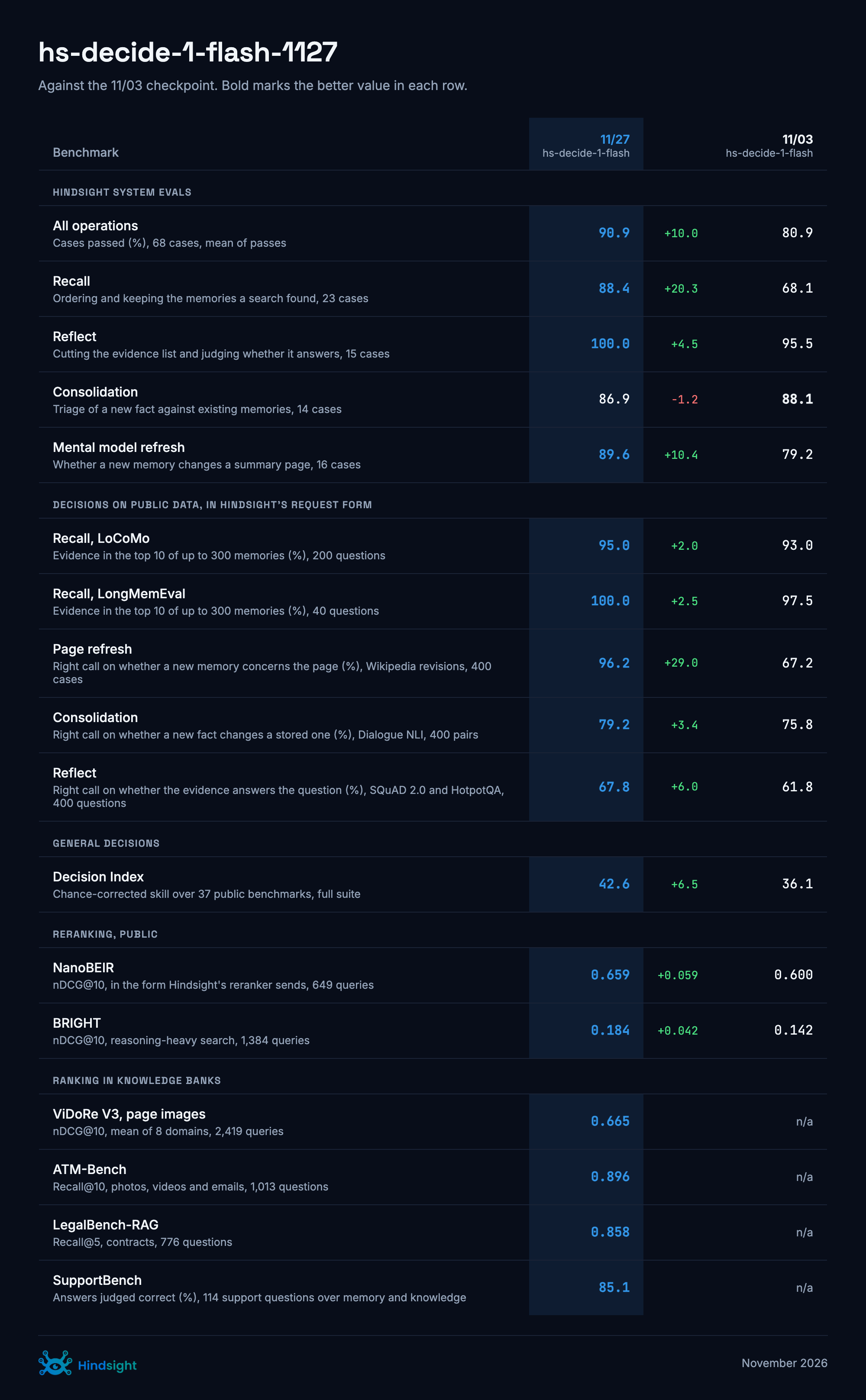
- Better in Hindsight. 90.9% of our system eval cases pass, up from 80.9%. Recall goes from 68.1% to 88.4%.
- Better general decisions. 42.6 on the Decision Index, up 6.5 points.
- Same name, same API. Still
hs-decide-1-flash: open weights on Hugging Face and live on Hindsight Inference, where requests with images go tohs-decide-1-flash-mm.
Images
Images are now a native part of the model. The same model makes decisions about images and ranks them. It can judge a photo, a screenshot or a PDF page, and rank pages and pictures against a query along with text.
Requests use the same System One API as TypeSafe's Jev 1.14, with images sent as named assets. An app written for that API works with hs-decide-1-flash by changing the model name.
We added a vision encoder and post-trained the model on rerank requests from real knowledge banks, along with PDF page images and photo search results, so it ranks images and text together.
Longer context
The new checkpoint handles requests up to 131,072 tokens. With memories of around 400 tokens, the first checkpoint could rank about 160 memories in one request before Hindsight had to split it. The new checkpoint ranks about 320.
Better performance in Hindsight
With the new checkpoint, Hindsight passes 90.9% of our system eval cases, up from 80.9% with the first one.
| Operation (cases) | First checkpoint | New checkpoint |
|---|---|---|
| Recall (23) | 68.1% | 88.4% |
| Reflect (15) | 95.5% | 100.0% |
| Mental model refresh (16) | 79.2% | 89.6% |
| Consolidation (14) | 88.1% | 86.9% |
| All operations (68) | 80.9% | 90.9% |
To see how well the model works on public data, we ran these datasets in the request format Hindsight sends:
- LoCoMo and LongMemEval simulate recall across a long memory history.
- Wikipedia revisions simulate knowledge pages whose information keeps changing.
- Dialogue NLI simulates the new facts that consolidation checks against stored ones.
- SQuAD 2.0 and HotpotQA simulate the questions that reflect answers from evidence.
Better general decisions
The Decision Index measures how well a model makes decisions outside of Hindsight across 37 public benchmarks. The new checkpoint scores 42.6, 6.5 points better than the first one's 36.1.
How to use it
Send images
Images can go in the state, the questions or the answer options. Put each image in assets and refer to it by name. On Hindsight Inference, send requests with images to hs-decide-1-flash-mm:
{
  "state": {
    "photo": "img-1",
    "note": "The customer says the screen arrived cracked."
  },
  "questions": {
    "damaged": {
      "type": "noul",
      "instructions": "Does img-1 show a damaged screen?"
    }
  },
  "assets": {
    "img-1": {
      "type": "image",
      "format": "png",
      "data_base64": "<base64 PNG>"
    }
  }
}
Hindsight Inference
The new checkpoint is live on Hindsight Inference, so you can call it at POST /v1/systemone with an API key and no GPU. There, hs-decide-1-flash takes text only, at $0.02 per million input tokens. To make decisions with images, call hs-decide-1-flash-mm, at $0.05 per million input tokens: PNG or JPEG, 280 to 1,568 pixels a side, up to 64 per request, each billed by its size. To use it from Hindsight, set HINDSIGHT_API_DECISION_MODEL_PROVIDER=hindsight and put your Hindsight Inference key in HINDSIGHT_API_DECISION_MODEL_API_KEY. Decision Models has every setting.
Run it yourself
The weights are on Hugging Face, and a plain download gets the new checkpoint. To pin it, add --revision 1127 to hf download. The first checkpoint stays at --revision 1103.
On a GPU with vLLM:
hf download hindsight-ai/hs-decide-1-flash --local-dir hs-decide-1-flash
pip install vllm==0.34.0 ./hs-decide-1-flash/serving
hindsight-decision serve hs-decide-1-flash \
  --port 8000 --api-key your-key
hindsight-decision serve also runs the model with MLX on an Apple silicon Mac (--engine mlx), or with Transformers on a CPU (--engine transformers). The model card has the install steps for each.
Then point Hindsight at your server:
export HINDSIGHT_API_DECISION_MODEL_PROVIDER=hindsight
export HINDSIGHT_API_DECISION_MODEL_BASE_URL=http://localhost:8000
export HINDSIGHT_API_DECISION_MODEL_API_KEY=your-key
Upgrading
Update Hindsight to 1.3.0 or later.
On Hindsight Inference, hs-decide-1-flash already serves the new checkpoint, so there's nothing to change.
On your own server, download the new weights, reinstall the serving package and restart it:
hf download hindsight-ai/hs-decide-1-flash --revision 1127 \
  --local-dir hs-decide-1-flash
pip install vllm==0.34.0 ./hs-decide-1-flash/serving
hindsight-decision serve hs-decide-1-flash \
  --port 8000 --api-key your-key
Then set Hindsight's request limit to the new window and turn on images:
export HINDSIGHT_API_DECISION_MODEL_MAX_REQUEST_TOKENS=120000
export HINDSIGHT_API_DECISION_MODEL_VISION=true
Try it
- Self-hosted Hindsight: run
hindsight-admin cloud loginand turn on the decision model. - Your own app: open the Playground, try the model, then create an API key (Inference docs).
- Open weights: get them on Hugging Face, and see every result on benchmarks.hindsight.vectorize.io.
- Star us on GitHub.