Stop Growing Your Always-On Context

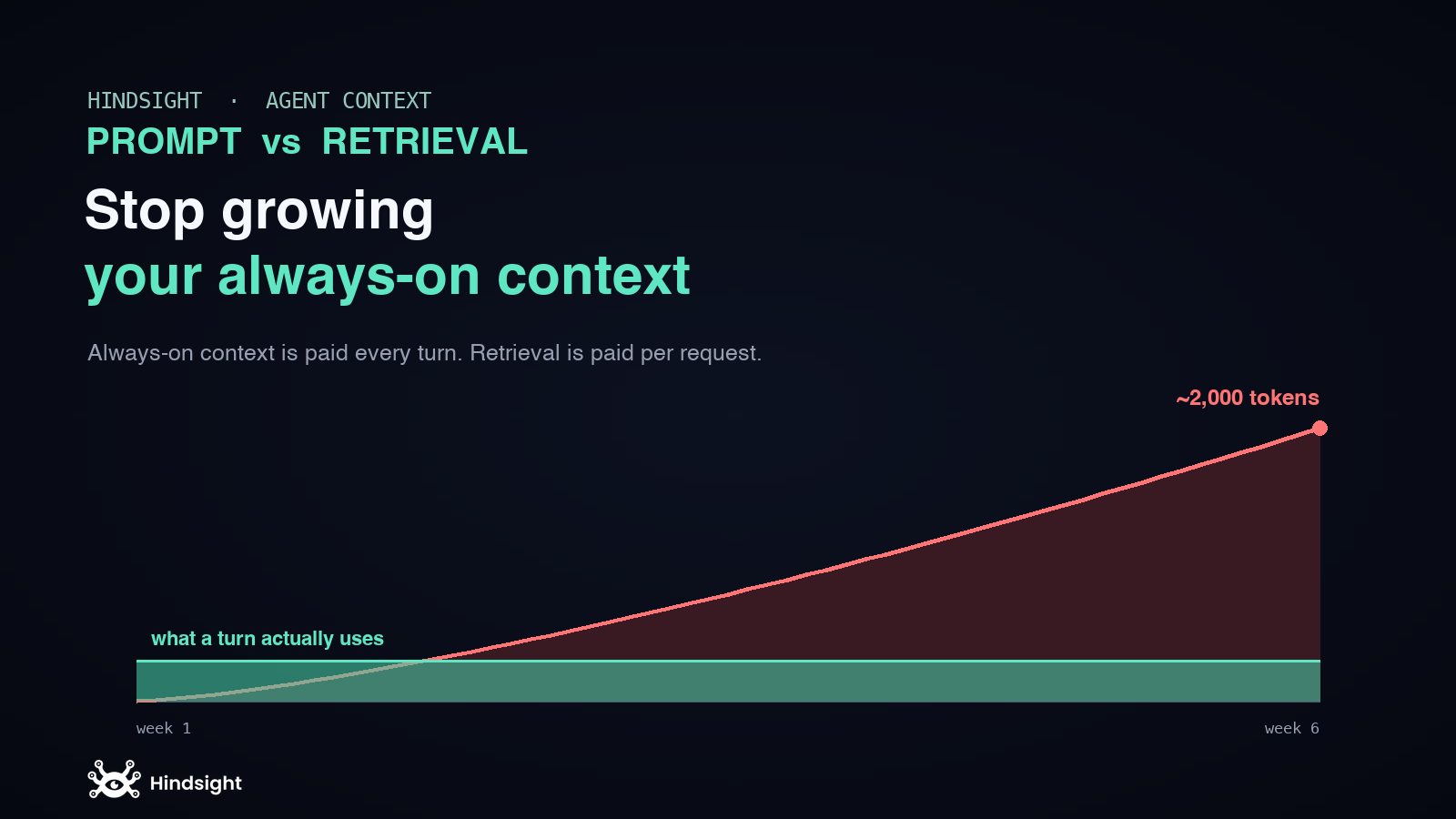
Every agent starts with a small system prompt, though these days it's more often a CLAUDE.md or an AGENTS.md than a string in your code. Call the whole thing the always-on context: the instructions your agent reads on every single turn, wherever they physically live. Then it gets something wrong, and you add a line. Then it gets something else wrong, and you add a paragraph. Six weeks later the prompt is two thousand tokens of accumulated correction, nobody remembers why half of it is there, and deleting any of it feels risky.
This is the most natural thing in the world to do, and for a while it's genuinely the right move. The question is what happens after that.
Why it works at first
Putting something in the prompt has real advantages, and it's worth being honest about them before arguing against it.
It's immediate. You add a line, the behaviour changes on the next turn. No indexing, no pipeline, no waiting.
It's certain. The model definitely saw it. There's no retrieval step that might have missed, no ranking that might have buried it. For a rule you actually need enforced every time, that certainty is worth a lot.
It's inspectable. The prompt is right there in your code. You can read it, diff it, and reason about it.
None of that stops being true at scale. What changes is the cost.
The cost is unconditional
A system prompt is paid on every turn, regardless of what the turn is about.
Two thousand tokens of accumulated instruction gets sent when the user asks you to rename a variable, and again when they ask for a migration plan, and again for a typo fix. The token cost is the obvious part and honestly the least interesting one. Two other things matter more.
It crowds out the actual task. Context is finite even when it's large, and everything spent on standing instruction is unavailable to the thing you're doing right now. In a long session, prompt bloat is competing directly with the code the agent needs to read.
Relevance falls as size grows. A model attending to twenty highly relevant lines behaves differently than one attending to two hundred lines of which twenty apply. You haven't just added noise around the signal; you've made the signal proportionally smaller. Adding a rule can genuinely make an existing rule less likely to be followed, which is a maddening thing to debug because the line you added is fine and the line that broke is untouched.
But my harness already handles this
The tooling has moved since the worst version of this problem. Standing context now lives in files rather than a string, scoped per project and sometimes per directory. Prompt caching means a stable prefix isn't billed at full rate on every turn. Harnesses compact long sessions automatically, hand work to subagents with their own windows, and load some instructions only when they look relevant.
All of that is real, and it genuinely changes the economics. It doesn't change the shape of the problem.
Caching cuts the price, not the crowding. On Anthropic's API, a cached prefix reads at roughly a tenth of the normal input rate; writing the cache costs about 25% more, and the default entry lives five minutes. That's a large saving on the least interesting of the three costs. The tokens still occupy the window, the model still attends to them, and a rule buried in two thousand tokens of standing instruction is no easier to follow for having been cheap to send.
Rules files ratchet harder than prompts did. A prompt in a Python string had one author. A file in version control has everyone, with the same asymmetry: adding is a one-line PR that nobody objects to, deleting requires proving a line is obsolete. Directory scoping genuinely helps, because a file that loads only inside services/api is conditional context and that's the right instinct. Most of what accumulates is project-wide anyway.
Compaction manages the symptom. Automatic summarization is what happens once the window is already full. It's lossy, it favours recent turns, and it fires in the middle of long tasks, which is exactly when losing earlier detail costs the most. It decides what to throw away after the fact; it doesn't decide what deserved to be resident in the first place.
Progressive disclosure is retrieval wearing a different hat. When a harness loads a skill or a scoped rules file only when it looks relevant, it has stopped putting that knowledge in the prompt and started retrieving it. That's this argument, already conceded and shipped. The open question is what happens to the knowledge your harness doesn't manage for you: what your team decided, what you tried, and why.
It only ever grows
Here's the structural problem. Adding to a system prompt is trivially easy and deleting from it is frightening.
Adding takes a moment and has an obvious motivation: something just went wrong. Deleting requires knowing that a line is obsolete, which usually means knowing why it was added, when, and whether the situation that caused it still exists. Nobody knows that six months later.
So prompts ratchet. Every incident adds a line, no incident removes one, and the natural equilibrium is "as large as we can tolerate." That's not a discipline failure. It's what happens to any structure where one direction is cheap and the other is scary.
What "put it in the prompt" is really doing
It helps to separate two things that get bundled together.
Instructions are things you want the agent to do, always, regardless of the task. Use this style. Never touch that directory. Ask before running migrations. These are genuinely unconditional, and the prompt is exactly the right place for them.
Knowledge is things that are true about your project. Why the retry policy excludes that endpoint. What was decided about rounding, and when. What someone tried last quarter that didn't work.
Knowledge is the part that grows without bound, and it's also the part that's almost never relevant to the current task. There is a lot of it, you need a small slice at a time, and which slice depends entirely on what you're doing right now.
Putting knowledge in the prompt means paying for all of it to get any of it.
Retrieval is the other option
The alternative isn't "remember less." It's to keep the knowledge somewhere queryable and pull the relevant part per turn.
That's what a memory system does, and the design consequence worth understanding is budget. In Hindsight, a recall runs under an explicit budget rather than returning whatever it finds. At the default fixed setting, a low budget pulls 100 items per retrieval method per fact type, mid pulls 300, and high pulls 1000. There's an adaptive mode that sizes the budget as a ratio of the request's own max_tokens instead.
The point isn't the specific numbers. It's that the cost is bounded and per-request rather than fixed and permanent. A trivial turn can retrieve almost nothing. A hard architectural question can pull a lot. Neither one pays for the other.
The second consequence is that knowledge stops needing a curator. A system prompt only contains what someone thought to write down, at the moment they thought to write it. A memory bank built from git history and past conversations contains what actually happened, including the decisions nobody remembered to document because they were made in a pull request thread at 6pm.
So what should the prompt hold?
Keep it. Make it the instruction layer.
- Standing behaviour you want on every single turn.
- Hard constraints, especially anything dangerous.
- Style and format rules the agent should never deviate from.
Move out anything that's really a record: decisions and their reasoning, architectural history, what was tried before, why a piece of code is shaped the way it is. Those belong somewhere retrievable, where they can be dated, attributed, and returned only when they bear on the question.
A good test: for each line in your prompt, ask whether it would still be worth sending if the current task were completely unrelated to it. If the answer is no, it's knowledge wearing an instruction's clothes.
The honest limits
Retrieval isn't free and it isn't magic.
It can miss. A prompt line is guaranteed to be seen; a retrieved memory has to be found first. For anything where being ignored is unacceptable, the prompt is still the right answer, and that's precisely why the instruction layer shouldn't be emptied out.
It adds a dependency. Something has to be running, and something has to have been captured.
And it needs time to become useful. A memory bank on day one knows less than a well-written prompt. The crossover comes later, and the trade only pays if you're working on something long-lived.
For a script you'll run twice, put it in the prompt. For a codebase you'll be in for a year, the prompt will lose that race, and it will lose it slowly enough that you won't notice which line broke.
Learn more
- Knowledge Pages for Coding Agents — a curated knowledge layer that maintains itself
- Cross-Encoder Reranking: The Last Stage of Agent Memory Recall — how a bounded retrieval budget gets spent
- Knowledge Graphs vs. Vector Search for Agent Memory — why retrieval runs several arms at once